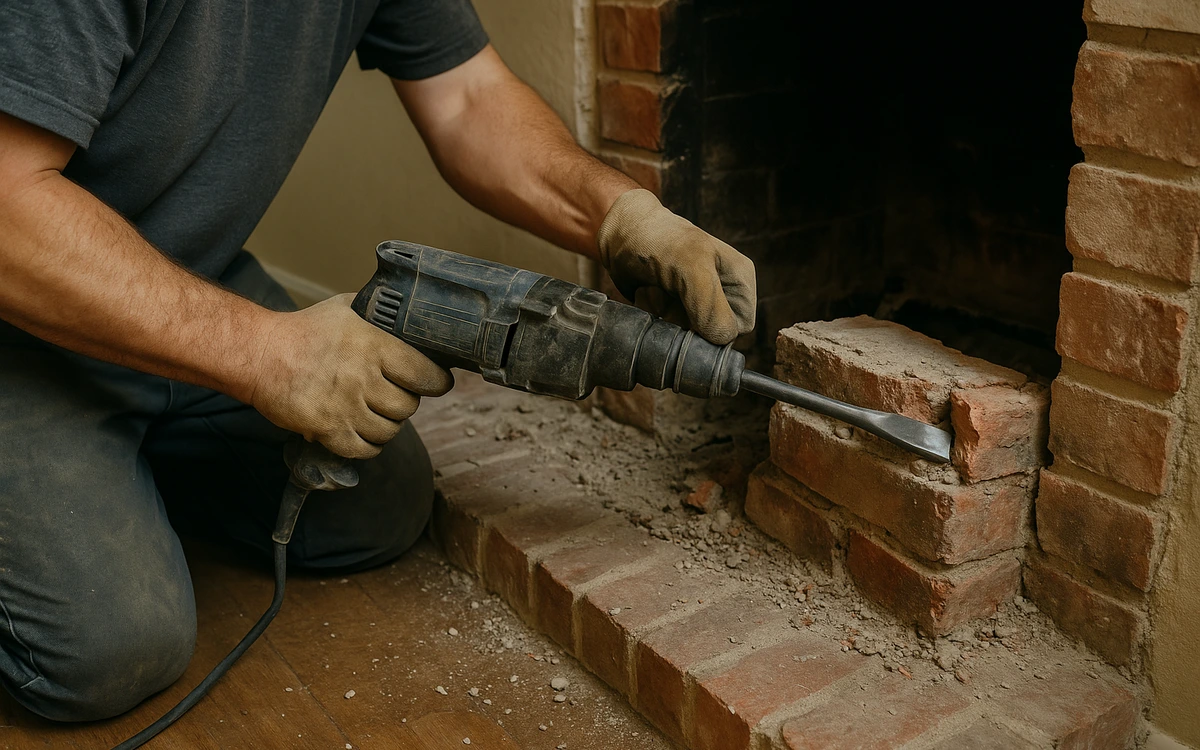
Can I Remove a Fireplace Myself and Patch the Opening?
No—DIY fireplace removal is one of those projects that can look straightforward at the firebox level but still go wrong fast. The masonry you see is tied into the chimney structure, hearth framing, and sometimes flue liner support, so removing the wrong section can leave a load path unsupported and allow air leakage or water intrusion. A pro removal means the flue is properly capped or rebuilt, the firebox is disconnected correctly, and the surrounding framing and roof/wall penetrations are sealed before drywall goes back in.
Is Fireplace Removal Just About Knocking Out the Firebox?
Not really—what you remove changes what has to be sealed, rebuilt, and inspected afterward. Gas and wood setups share the same core issue: the flue and combustion air pathways can keep drawing in outside air, moisture, or combustion gases if they’re only partially addressed. Your contractor should plan for the flue closure method, damper and liner handling, hearth and surround demolition, and proper sealing of the chase so drafts don’t show up after the project is “done.”
Does Timing Matter, Since You Can Remove It Any Time?
Timing changes what can be inspected and what materials perform correctly, so “any time” isn’t the best answer. Masonry and exterior penetrations need dry conditions for proper sealing and for patch materials to cure without trapping moisture in the chimney chase. If you’re in a wet season, you can still demo safely, but the sealing, flashing work, and final interior closure are often scheduled to avoid curing in damp weather that later leaks.
How Do I Know Fireplace Removal Is Needed (Not Just a Repair)?
You can spot the difference by how the fireplace and its chase behave, not just by how it looks at first glance. Fireplace removals become the right fix when the remaining system is structurally compromised, trapped-draft prone, or failing in a way repair won’t stop. Watch for these concrete signs before you commit to demolition versus rebuild.
- Persistent drafts from the fireplace chase
- Water stains near the damper opening
- Soot smell lingering without recent fires
- Loose or cracked firebox/fireplace surround
- Cracked chimney chase bricks or mortar
Will Closing the Fireplace Prevent Problems Without Removing the Chimney Parts?
Usually no—closing the opening alone doesn’t stop the flue’s movement of air and moisture through the chimney assembly. Chimney flues can still create negative pressure and allow humid air to condense on cooler liner sections, which then feeds staining and odors inside the chase. A proper removal approach either eliminates the chimney penetration or seals the flue liner and chase so there’s no remaining pathway for water vapor, debris, and odors to enter the home.
How Much Does Fireplace Removal Cost?
Fireplace removal usually costs between $850 and $2,250 as a one-time project, since the crew must disconnect the firebox, cap or rebuild the flue, and safely remove the masonry and hearth framing. The total typically depends on how much masonry and chase area needs to be removed, along with site conditions such as roof or exterior penetration sealing and access for dust and debris. Final costs can also vary based on whether gas lines, dampers, and surrounding drywall need replacement, as well as any code-required inspection.
Our Service Area
We provide services nationwide, including in the following cities:
Alabama
- Anniston, AL
- Birmingham, AL
- Decatur, AL
- Dothan, AL
- Florence, AL
- Huntsville, AL
- Mobile, AL
- Montgomery, AL
- Selma, AL
- Tuscaloosa, AL
Alaska
Arizona
Arkansas
- El Dorado, AR
- Fayetteville, AR
- Fort Smith, AR
- Jonesboro, AR
- Little Rock, AR
- Pine Bluff, AR
- Rogers, AR
- Springdale, AR
California
- Bakersfield, CA
- Chico, CA
- El Centro, CA
- Eureka, CA
- Fresno, CA
- Los Angeles, CA
- Modesto, CA
- Monterey, CA
- Oakland, CA
- Palm Springs, CA
- Redding, CA
- Sacramento, CA
- Salinas, CA
- San Diego, CA
- San Francisco, CA
- San Jose, CA
- San Luis Obispo, CA
- Santa Barbara, CA
- Santa Maria, CA
- Stockton, CA
- Visalia, CA
Colorado
Connecticut
District of Columbia
Florida
- Daytona Beach, FL
- Fort Lauderdale, FL
- Fort Myers, FL
- Fort Pierce, FL
- Fort Walton Beach, FL
- Gainesville, FL
- Jacksonville, FL
- Melbourne, FL
- Miami, FL
- Naples, FL
- Orlando, FL
- Panama City, FL
- Pensacola, FL
- Sarasota, FL
- St. Petersburg, FL
- Tallahassee, FL
- Tampa, FL
- West Palm Beach, FL
Georgia
Hawaii
Idaho
Illinois
- Bloomington, IL
- Champaign, IL
- Chicago, IL
- Decatur, IL
- Harrisburg, IL
- Moline, IL
- Peoria, IL
- Quincy, IL
- Rock Island, IL
- Rockford, IL
- Springfield, IL
- Urbana, IL
Indiana
- Elkhart, IN
- Evansville, IN
- Fort Wayne, IN
- Indianapolis, IN
- Lafayette, IN
- South Bend, IN
- Terre Haute, IN
Iowa
- Ames, IA
- Cedar Rapids, IA
- Davenport, IA
- Des Moines, IA
- Dubuque, IA
- Iowa City, IA
- Keokuk, IA
- Mason City, IA
- Ottumwa, IA
- Sioux City, IA
- Waterloo, IA
Kansas
Kentucky
Louisiana
- Alexandria, LA
- Baton Rouge, LA
- Lafayette, LA
- Lake Charles, LA
- Monroe, LA
- New Orleans, LA
- Shreveport, LA
Maine
Maryland
Massachusetts
Michigan
- Alpena, MI
- Battle Creek, MI
- Bay City, MI
- Cadillac, MI
- Detroit, MI
- Flint, MI
- Grand Rapids, MI
- Kalamazoo, MI
- Lansing, MI
- Marquette, MI
- Saginaw, MI
- Traverse City, MI
Minnesota
Mississippi
- Biloxi, MS
- Columbus, MS
- Greenville, MS
- Greenwood, MS
- Gulfport, MS
- Hattiesburg, MS
- Jackson, MS
- Laurel, MS
- Meridian, MS
- Starkville, MS
- Tupelo, MS
- West Point, MS
Missouri
- Cape Girardeau, MO
- Columbia, MO
- Hannibal, MO
- Jefferson City, MO
- Joplin, MO
- Kansas City, MO
- Kirksville, MO
- Springfield, MO
- St. Joseph, MO
- St. Louis, MO
Montana
Nebraska
Nevada
New Hampshire
New Mexico
New York
- Albany, NY
- Binghamton, NY
- Buffalo, NY
- Corning, NY
- Elmira, NY
- New York, NY
- Plattsburgh, NY
- Rochester, NY
- Schenectady, NY
- Syracuse, NY
- Troy, NY
- Utica, NY
- Watertown, NY
North Carolina
- Asheville, NC
- Charlotte, NC
- Durham, NC
- Fayetteville, NC
- Greensboro, NC
- Greenville, NC
- High Point, NC
- New Bern, NC
- Raleigh, NC
- Washington, NC
- Wilmington, NC
- Winston-Salem, NC
North Dakota
Ohio
- Akron, OH
- Canton, OH
- Cincinnati, OH
- Cleveland, OH
- Columbus, OH
- Dayton, OH
- Lima, OH
- Steubenville, OH
- Toledo, OH
- Youngstown, OH
- Zanesville, OH
Oklahoma
Oregon
Pennsylvania
- Altoona, PA
- Erie, PA
- Harrisburg, PA
- Hazleton, PA
- Johnstown, PA
- Lancaster, PA
- Lebanon, PA
- Philadelphia, PA
- Pittsburgh, PA
- Scranton, PA
- State College, PA
- Wilkes-Barre, PA
- York, PA
Rhode Island
South Carolina
- Aiken, SC
- Anderson, SC
- Charleston, SC
- Columbia, SC
- Florence, SC
- Greenville, SC
- Myrtle Beach, SC
- Spartanburg, SC
South Dakota
Tennessee
Texas
- Abilene, TX
- Amarillo, TX
- Austin, TX
- Beaumont, TX
- Brownsville, TX
- Bryan, TX
- Corpus Christi, TX
- Dallas, TX
- El Paso, TX
- Fort Worth, TX
- Harlingen, TX
- Houston, TX
- Laredo, TX
- Longview, TX
- Lubbock, TX
- Lufkin, TX
- McAllen, TX
- Midland, TX
- Nacogdoches, TX
- Odessa, TX
- Port Arthur, TX
- San Angelo, TX
- San Antonio, TX
- Sherman, TX
- Sweetwater, TX
- Temple, TX
- Texarkana, TX
- Tyler, TX
- Victoria, TX
- Waco, TX
- Weslaco, TX
- Wichita Falls, TX
Utah
Vermont
Virginia
- Bristol, VA
- Charlottesville, VA
- Harrisonburg, VA
- Lynchburg, VA
- Newport News, VA
- Norfolk, VA
- Petersburg, VA
- Portsmouth, VA
- Richmond, VA
- Roanoke, VA
Washington
West Virginia
- Beckley, WV
- Bluefield, WV
- Charleston, WV
- Clarksburg, WV
- Huntington, WV
- Oak Hill, WV
- Parkersburg, WV
- Weston, WV
- Wheeling, WV
Wisconsin
- Appleton, WI
- Eau Claire, WI
- Green Bay, WI
- La Crosse, WI
- Madison, WI
- Milwaukee, WI
- Rhinelander, WI
- Superior, WI
- Wausau, WI